

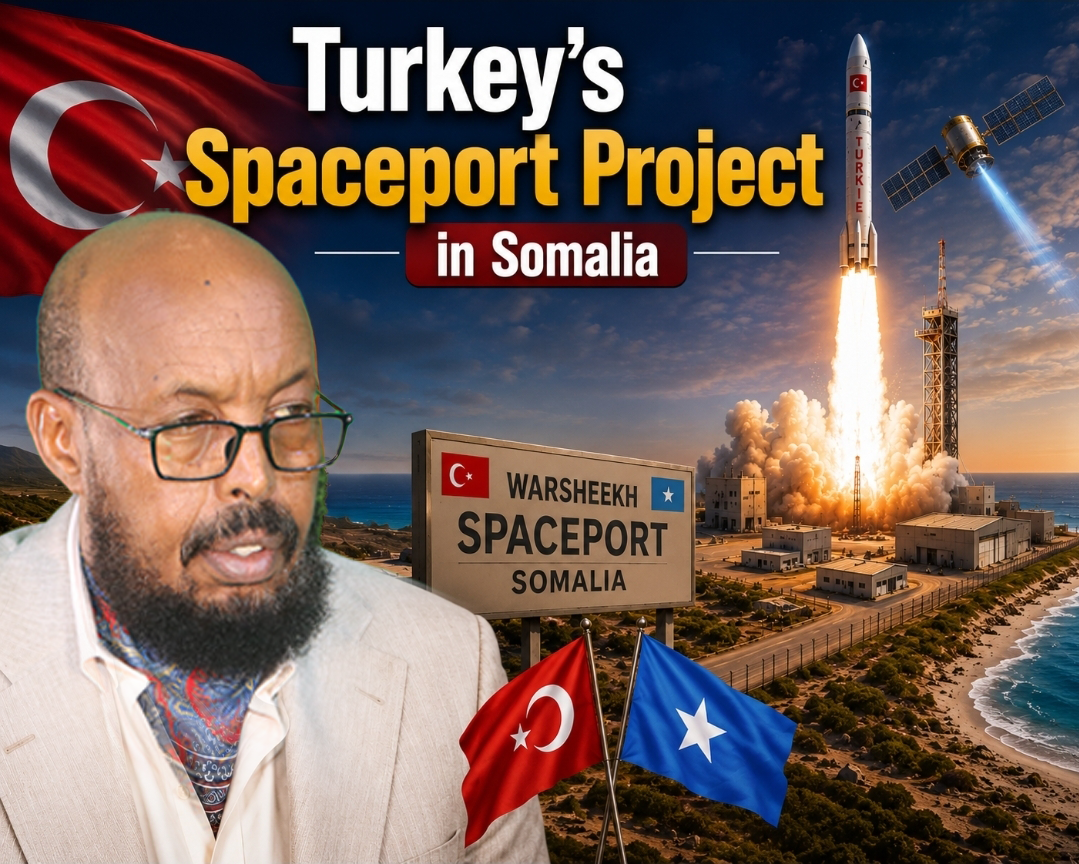

Turkey’s decision to build a space launch facility in Somalia marks one of the most significant technological partnerships ever undertaken between the two countries. Beyond the symbolism of launching rockets into space, the project reflects broader shifts in geopolitics, economic diplomacy and scientific ambition. If completed as planned, the spaceport near Warsheikh will not simply provide Turkey with a gateway to orbit; it could redefine Somalia’s role in Africa’s emerging space economy while strengthening Ankara’s strategic influence across the Horn of Africa.
The project demonstrates how international partnerships have evolved beyond traditional aid and humanitarian assistance. During the past decade, Turkey has invested heavily in Somalia’s infrastructure, health services, education, transport and security institutions. The proposed spaceport represents the next stage of that relationship—one based increasingly on technology, innovation and long-term strategic cooperation. Rather than focusing solely on reconstruction, the partnership is moving into sectors normally associated with advanced industrial economies.
Geography lies at the heart of Turkey’s decision. Somalia occupies one of the world’s most advantageous positions for launching satellites because it lies close to the equator. Rockets launched near the equator benefit from the Earth’s rotational speed, allowing them to carry heavier payloads while consuming less fuel. This translates into lower launch costs and improved commercial competitiveness. Countries with equatorial launch sites, such as French Guiana, have long enjoyed this natural advantage, and Somalia now possesses an opportunity to join this exclusive group.
Warsheikh offers another valuable characteristic: its long, open coastline along the Indian Ocean. Rocket boosters and other launch components can safely fall into uninhabited waters instead of populated regions, making operations both safer and more efficient. These geographical advantages explain why several space agencies worldwide continue to seek coastal equatorial launch sites despite the considerable investment required.
For Turkey, the project forms part of a broader national vision. Over the past several years, Ankara has invested heavily in satellite production, aerospace engineering, drone technology and indigenous defence industries. Establishing an overseas launch facility would reduce dependence on foreign launch providers and strengthen Turkey’s ambition to become one of the relatively few nations capable of independently placing satellites into orbit. Such capability carries scientific, commercial and national prestige, positioning Turkey alongside countries that view space technology as an essential component of economic development.
The commercial opportunities are equally important. Global demand for satellite launches continues to grow as governments and private companies expand communications, navigation, weather forecasting and Earth-observation services. The rise of small satellites has created a competitive international launch market where lower costs can attract customers from around the world. Turkish officials believe the Somalia facility could eventually serve not only Turkey but also other countries seeking affordable access to space.
The project also illustrates how the global space industry is becoming increasingly international. Space exploration is no longer limited to traditional powers such as the United States and Russia. China, India, the United Arab Emirates and several middle-income countries have expanded their space ambitions during the past decade. Turkey’s investment reflects this wider trend in which technological capability has become an important measure of national influence alongside economic and military strength.
For Somalia, the potential benefits extend well beyond the launch pad itself. Large infrastructure projects often create employment during construction while stimulating local businesses that provide transport, logistics, accommodation and services. If managed effectively, the spaceport could encourage technology transfer, engineering education, scientific research and specialised vocational training. Universities may eventually expand programmes in physics, aerospace engineering, telecommunications and computer science to meet future workforce demands. Such developments could contribute to building a knowledge-based economy rather than relying solely on traditional sectors.
Equally significant is the message the investment sends to international markets. For many years, Somalia has been viewed primarily through the lens of conflict and humanitarian challenges. A major high-technology project backed by a foreign government presents a different narrative—one focused on long-term confidence, strategic investment and future economic opportunities. While challenges remain, such projects can gradually reshape international perceptions of the country’s investment potential.
Nevertheless, the project has attracted geopolitical attention. Some defence analysts argue that space-launch technology shares engineering similarities with long-range missile systems, leading to speculation about possible military applications. Turkish officials consistently reject this interpretation, describing the facility as a civilian and commercial spaceport dedicated to peaceful scientific research and satellite launches. Regardless of differing assessments, the project demonstrates how advanced technology increasingly occupies the intersection of science, commerce and national security.
The wider geopolitical implications are difficult to ignore. Turkey has steadily expanded its diplomatic and economic footprint throughout Africa over the past two decades. Somalia has become one of Ankara’s closest strategic partners, hosting Turkey’s largest overseas military training base and receiving substantial investment in ports, airports, healthcare and public infrastructure. The addition of a spaceport reinforces Turkey’s long-term commitment while strengthening its presence near one of the world’s busiest maritime corridors linking the Indian Ocean, the Red Sea and the Gulf of Aden.
Ultimately, the significance of the Warsheikh spaceport extends far beyond rockets and satellites. It represents a new phase in Somalia-Turkey relations built on science, technology and strategic cooperation. It also reflects broader changes in global politics, where influence increasingly depends not only on military power or economic size but also on technological capability and innovation.
If construction proceeds according to schedule, the project could become one of the most transformative technological investments in Somalia’s modern history. More importantly, it may demonstrate that partnerships between developing nations can evolve beyond aid into ambitious collaborations capable of shaping the industries of the future. Whether viewed through the lens of economics, geopolitics or scientific progress, the proposed spaceport signals that both Somalia and Turkey are aiming considerably higher than before—quite literally, toward space.
Mohamed Mohamoud Adde is an academic and a geopolitical analyst