

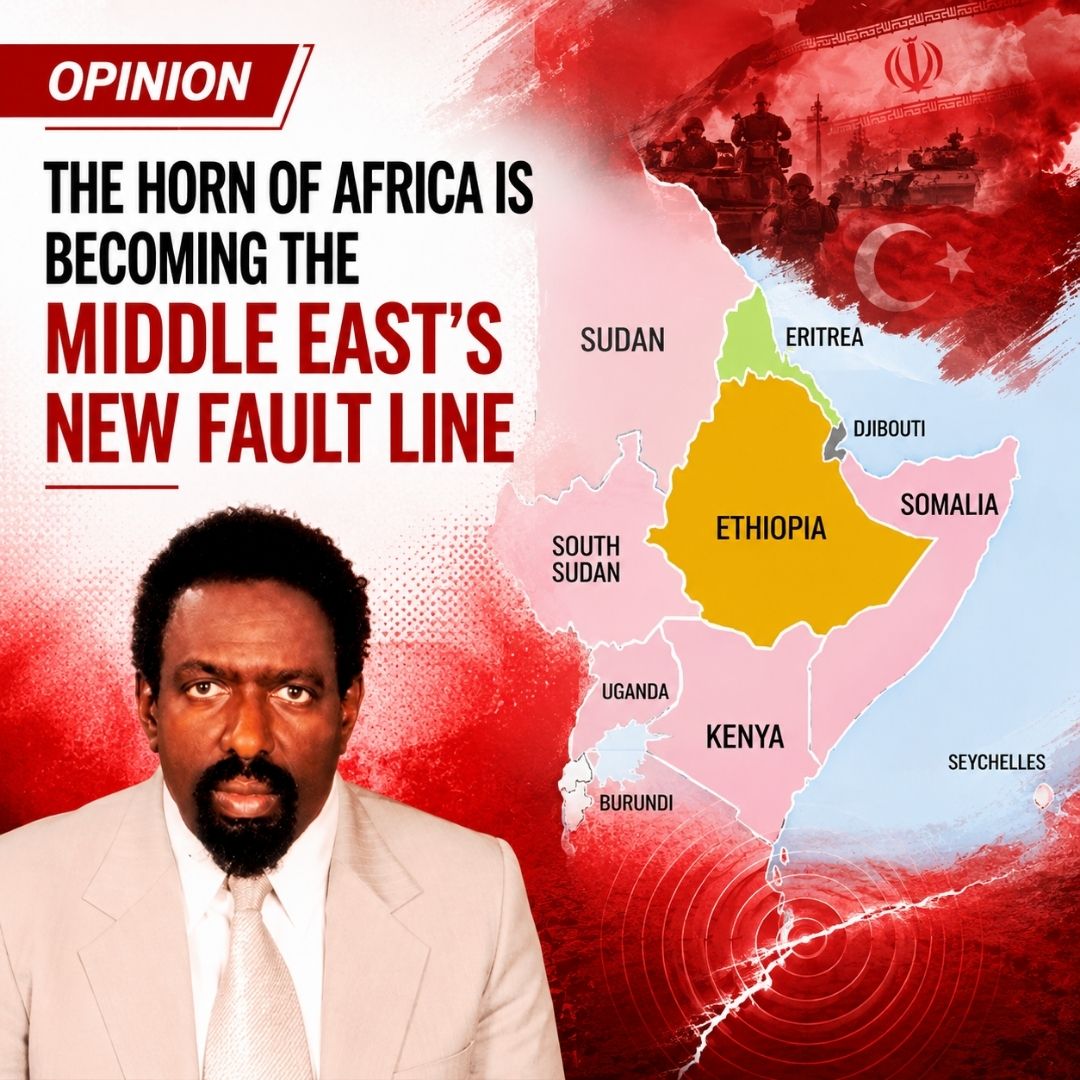

Israel’s recognition of Somaliland, a new Mecca defence pact, and a fraying clan peace in Awdal are pulling a once-peripheral corner of Africa into the center of Middle Eastern security politics.
Eight months ago, Israel did something no other country had done in three decades: It recognized Somaliland as a sovereign state. At the time, the move looked like a diplomatic gesture — a reward for a functioning democracy that the rest of the world had spent thirty years pretending did not exist. It is now clear that it was something more consequential. Israel’s recognition has become the opening move in a contest for control of the Horn of Africa, one that is drawing in a new Mecca defence bloc, hardening old rivalries over the Red Sea, and destabilizing a corner of Somaliland that had, until this year, been a rare example of durable peace.
Washington should be paying far closer attention than it is.
Why Israel Bet on Somaliland
Somaliland’s appeal to Israel was never really about democracy promotion. It was about geography. The territory sits roughly 260 kilometres across the Gulf of Aden from Yemen, a country substantially controlled by the Houthi movement. Flying out of Berbera International Airport cuts the distance to Sanaa to around 550 kilometres, compared with more than 1,800 kilometres from Israel itself — a nearly 70 percent reduction in flight distance. The airfield, built by Soviet engineers during the Cold War, can already handle heavy transport aircraft, fighter jets, and surveillance drones, and it sits beside a deep-water port where the United Arab Emirates has invested for years.
In short, Somaliland offers Israel something it has lacked since ties with Sudan collapsed and Eritrea drifted away: a forward operating platform near one of the world’s most dangerous chokepoints. Officials in Jerusalem have likened the arrangement to Azerbaijan’s role in Israel’s northern strategy against Iran — a discreet, forward-positioned partner that expands the reach of Israeli intelligence and logistics without requiring a formal base.
The buildup since December has been rapid, if carefully unofficial. Somaliland officers, including members of the presidential guard and intelligence services, have trained in Israel. Israeli teams have surveyed Somaliland’s coastline for potential sites for facilities. Journalists have documented what looks like an Israeli intelligence footprint at Berbera Airport, even as both governments deny any formal basing agreement exists. That ambiguity is almost certainly deliberate: cooperation without a declared installation denies Mogadishu, Ankara, and the Houthis a clear target to point to — or strike.
Mogadishu’s Fury, and Why It Matters
Somalia’s government does not see any of this as a minor diplomatic slight. It sees it as an existential threat. Somalia treats territorial integrity as a constitutional absolute, and its leaders fear that international recognition of Somaliland could set off a broader unravelling — emboldening other breakaway-minded regions and inviting outside powers to exploit the country’s internal divisions. President Hassan Sheikh Mohamud has called Israel’s move a “trap” and vowed to resist any Israeli presence on what Mogadishu still considers Somali soil. His government insists that only the federal authorities in Mogadishu can authorize foreign security arrangements anywhere in the country — including in Somaliland. Turkey, Egypt, Qatar and Pakistan have all publicly backed that position.
This is where the story stops being a bilateral dispute between Hargeisa and Mogadishu and starts becoming a regional one.
Enter the Mecca Pact
In August, Saudi Arabia, Turkey and Pakistan signed the Mecca Joint Defence Agreement, a new collective-security arrangement among three of the Sunni Muslim world’s most militarily capable states. Somalia is not a signatory. But the pact effectively supercharges Mogadishu’s existing bilateral ties with all three powers and, in doing so, reshapes the strategic map around Somaliland.
The reinforcement runs on several tracks at once. Turkey already operates its largest overseas military base, Camp TurkSom, in Mogadishu. Saudi Arabia and Pakistan have each signed new defence memoranda with Somalia this year. Saudi-funded training has put roughly 5,000 Somali soldiers through a nine-month program, including some 2,000 recruits drawn specifically from Puntland& N.E State — a detail that matters because it extends Mogadishu’s military reach into contested northern territory near Somaliland’s own periphery. At sea, the pact dovetails with Somalia’s expanding naval cooperation with both Turkey and Pakistan, strengthening Mogadishu’s hand in the waters around the Bab el-Mandeb strait.
The diplomatic effect may prove just as important as the military one. By opposing Israel’s recognition of Somaliland as a bloc, the Mecca signatories raise the political cost of any other country following Israel’s lead. Every government now weighing whether to recognize Somaliland has to reckon not just with Somali objections but with a defence pact spanning the Arabian Peninsula, Anatolia and South Asia. That calculus alone may be enough to freeze Somaliland’s recognition campaign in place — even as military pressure from Mogadishu increases, and Somaliland finds itself cast as a forward outpost in a wider contest pitting Israel, the UAE and possiblyEthiopia against Saudi Arabia, Turkey, Pakistan and Egypt.
The Strait That Explains Everything
None of this makes sense without Bab el-Mandeb, the narrow passage between the Horn of Africa and the Arabian Peninsula that has become the strategic center of gravity for the entire dispute. Between 9 and 15 percent of the world’s oil and liquefied natural gas, and roughly 12 percent of global trade, pass through the strait. When traffic is disrupted, ships must reroute around the southern tip of Africa, adding 10 to 14 days to voyages and enormous costs to global supply chains. In 2023 and 2024, the Houthis have used drones and missiles to threaten exactly that traffic. Djibouti, Eritrea, Somalia and Somaliland all sit along this corridor, which is precisely why a stretch of coastline that most Americans could not find on a map has become indispensable to global maritime security.
The cast of interested parties is correspondingly large: the Houthi movement and Yemen’s national forces on one side; Djibouti, Eritrea, Saudi Arabia, Egypt and the UAE as regional stakeholders with their own bases and port investments; the United States, China and Iran — which backs the Houthis — as the great powers watching from further afield; and piracy networks that have historically thrived whenever state authority in the area weakens. Israel’s interest in Somaliland cannot be separated from this picture. Securing a foothold near Bab el-Mandeb is, for Jerusalem, inseparable from the broader project of containing Houthi coercion of Red Sea shipping.
The Local Cost: Awdal’s Fraying Peace
It is tempting to read all of this as a contest fought entirely over the heads of ordinary people. It isn’t. In Awdal, a region in western Somaliland, tension between the Gadabuursi and Issa clans has intensified in ways that many local analysts believe are less organic than engineered.
For decades, Awdal was one of the most reliably peaceful inter-clan regions in the Horn of Africa. Customary law, deep economic interdependence, respected traditional leadership, cross-border kinship ties, a shared Islamic identity and complementary territorial arrangements combined to produce a genuinely stable social order. That order is now under strain, and the reasons have less to do with the Gadabuursi and Issa communities themselves than with the governments and powers arrayed around them.
Djibouti wants to preserve its dominance over regional port traffic. Somaliland wants to raise Berbera’s profile as regional powers jockey for position. Local political figures on both sides have incentives to exploit the resulting friction to consolidate their own influence. The clan territories that straddle the Djibouti-Somaliland border, in other words, have become strategically valuable in their own right — useful for security, logistics and surveillance — which gives outside actors every reason to keep the rivalry simmering rather than let it cool. Djibouti’s Issa-led government watches any shift in the borderlands warily, and Gadabuursi communities increasingly read Issa mobilization as encroachment. Meanwhile, Saudi-funded training of Puntland and other northern units may be emboldening federal influence in border areas, and joint Somali-Djiboutian opposition to Somaliland’s recognition bid indirectly ratchets up pressure in Awdal itself. The SSC-Khaatumo conflict of 2023 and 2024 already exposed how fragile Somaliland’s periphery can be — and Awdal’s stability has become essential to Somaliland’s argument, on the world stage, that it is cohesive enough to deserve recognition and stable enough to host a foreign partner.
The strategic stakes of local unrest are not abstract. For Somaliland, instability in Awdal undercuts the central claim underlying its case for recognition and for hosting foreign installations: that it is a coherent, governable state. For Israel and the UAE, clan tension complicates any quiet basing arrangement near Berbera. For Somalia, Djibouti and the Mecca bloc, an unstable Awdal offers useful leverage against Somaliland’s territorial claims. And for Djibouti itself, the Issa-Gadabuursi tension intersects with a security calculus already complicated by the presence of American, Chinese, French, and Japanese bases within a few square miles of one another. Awdal, in short, has become a microcosm of the wider struggle: a local dispute amplified, and in some telling manufactured, by global competition.
Three Axes, One Region
Step back, and the outlines of a new regional order come into focus. Three strategic axes are forming around the Horn of Africa. The first — Israel, the UAE, Ethiopia and Somaliland — is focused on containing the Houthis and securing Bab el-Mandeb, with Berbera as its preferred forward platform. The second — Saudi Arabia, Turkey, Pakistan, Egypt and Somalia, bound together by the Mecca pact — opposes Somaliland’s recognition and is working to preserve its own dominance over Red Sea security. The third is the familiar great-power overlay of American and Chinese competition, with Djibouti as the central node; both powers are watching for any sign that Berbera’s role is expanding at Djibouti’s expense.
Awdal sits at the intersection of nearly all of these currents: Somaliland’s recognition campaign, Israel’s basing calculus, Djibouti’s border anxieties, Somalia’s newly reinforced military posture, and the broader Gulf rivalry over who controls Red Sea security. What happens to a few thousand square miles of contested clan territory now carries consequences well beyond the Horn.
What Comes Next — and Why Washington Should Care
The Israel-Somaliland relationship is likely to remain deliberately ambiguous for some time: real enough to sustain intelligence cooperation, but deniable enough to avoid detonating a regional crisis. The Mecca agreement strengthens Somalia’s hand and narrows Somaliland’s diplomatic room to maneuver. And Bab el-Mandeb’s vulnerability guarantees that the militarization of the Red Sea corridor will continue regardless of what happens in Hargeisa or Mogadishu.
Several open questions will determine what the next phase looks like: whether Israel eventually formalizes a presence at Berbera; whether the Mecca bloc escalates diplomatic or military pressure on Somaliland; whether Awdal’s clan tensions stabilize or spiral further; whether a Houthi strike forces either Israel or Somaliland to abandon strategic ambiguity; and, not least, whether Washington reconsiders its long-standing “One Somalia” policy, which has so far left the United States a bystander to a contest playing out in a region of genuine strategic importance to it.
The Horn of Africa is no longer a peripheral theatre in Middle Eastern politics. It is fast becoming one of its central nodes — and the decisions being made in Hargeisa, Mogadishu, Jerusalem, Riyadh and Djibouti over the coming months will likely determine whether it becomes a stable new security architecture or the next flashpoint in a region that has no shortage of them.
About the Author
Dr. Saad Awale is a retired physician with over than 36 years of experience in clinical medicine, surgery, emergency care, and health administration, having served as a Clinical Service Manager, Special Projects Manager in an Ambulatory Healthcare Services setting, and as a Healthcare Services Coordinator.
Sources and Notes
On the scale of Saudi-funded training in Somalia: Reporting from Somalia Today, the Horn Review, and the Somali Report converges on a program of roughly 5,107 recruits — about 2,000 of them from Puntland — trained over nine months in Guri’el, Galgudud, with a follow-up report on the graduation of roughly 3,000 trainees from the same program.
On maritime cooperation: Somalia’s naval cooperation with Turkey has been reported by Anadolu Agency and Reuters, citing Somalia’s Ministry of Defence; cooperation with Pakistan has been reported by the Pakistan Navy, Somalia’s Ministry of Defence, and Dawn.
On the quoted remarks: President Hassan Sheikh Mohamud’s description of Israel’s recognition as a “trap” was made during an interview on the Miisaan Podcast, broadcast on Dawan Media and reported by Somalia Today. His pledge to “confront any Israeli presence” was reported by Al Jazeera.
DISCLAIMER: The views and information expressed in this article are those of the author and do not reflect the views of Horn Broadcasting Network (HBN).