

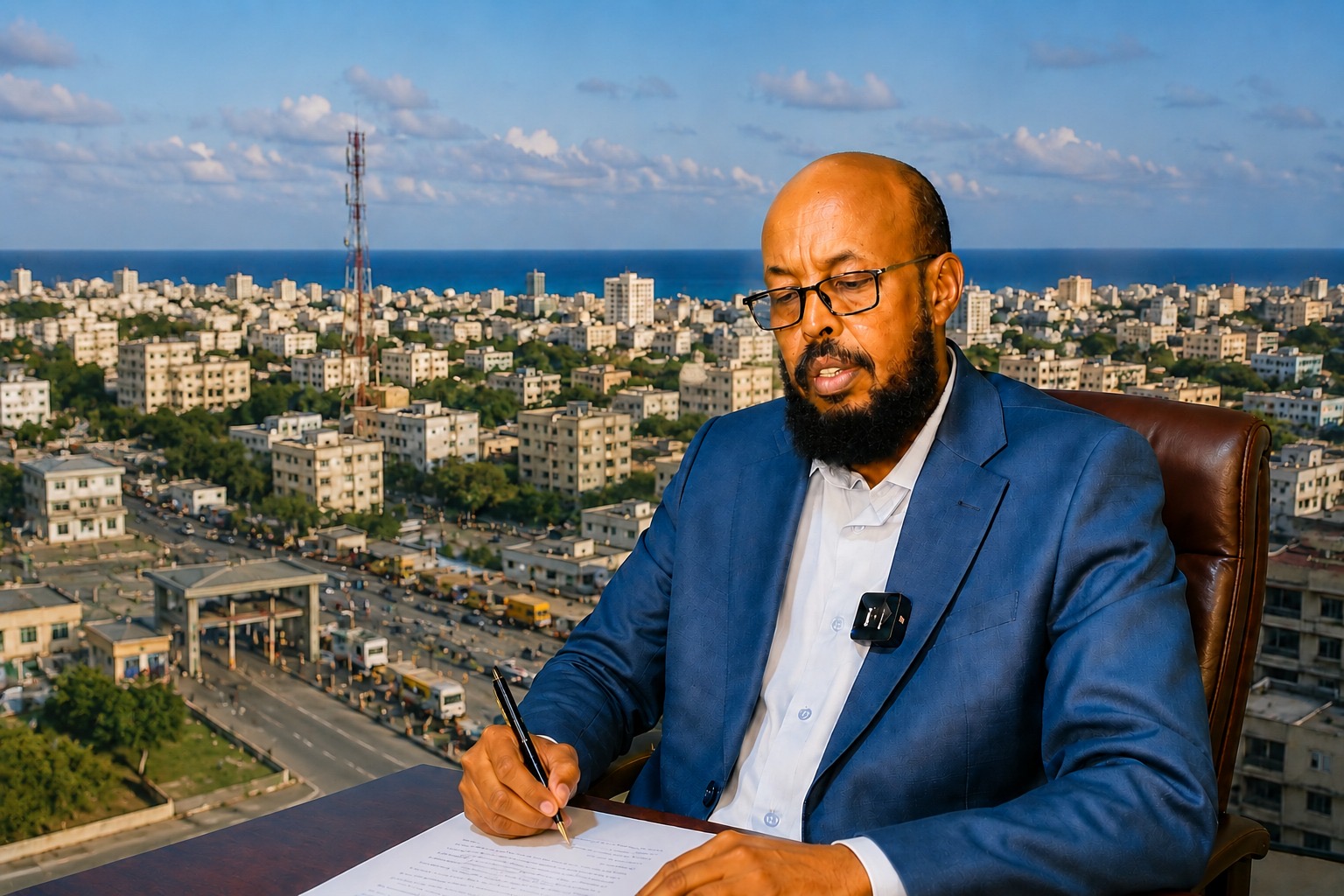

For decades, security in Somalia’s capital, Mogadishu, remained one of the country’s greatest concerns. The city endured repeated security threats, including bombings, assassinations, illegal checkpoints, and militant infiltration. However, recent developments indicate that the security management of the Somali capital has improved considerably. While challenges still exist, there are visible changes that suggest Mogadishu is gradually embracing a more modern and organised security architecture.
One of the most noticeable developments in Mogadishu today is the transformation of security checkpoints. Unlike previous years, when checkpoints often relied heavily on manual inspection and physical searches, many checkpoints are now staffed by trained security officers equipped with modern digital tools, including iPads and electronic systems that help identify vehicles and individuals more efficiently.
This technological shift has enabled security agencies to maintain databases that assist them in monitoring traffic movement and identifying suspicious patterns. The availability of digital records at checkpoints allows officers to cross-check information quickly and reduce delays while strengthening security screening. Somalia’s broader governance reforms increasingly emphasize technology and digital systems to strengthen institutions and service delivery.
Another important addition to Mogadishu’s evolving security apparatus is the growing deployment of trained sniffing dogs at major checkpoints, government facilities, and strategic locations. These specially trained dogs are used to detect explosives, hidden weapons, and suspicious materials inside vehicles and luggage. In many countries facing security threats, canine units play an essential role in preventing attacks before they occur.
The use of sniffer dogs in Mogadishu reflects an understanding that human observation alone is sometimes insufficient in detecting sophisticated explosive devices. Dogs trained in explosive detection possess an extraordinary sense of smell, enabling them to identify dangerous materials far more quickly than ordinary manual inspection. Their deployment adds another layer of protection to checkpoint operations and enhances public confidence in security institutions.
At the same time, authorities appear increasingly aware that the use of sniffing dogs in public spaces requires cultural sensitivity and careful public engagement. In a predominantly Muslim society such as Somalia, where interactions with dogs can sometimes be viewed cautiously due to cultural and religious considerations, security institutions may need to ensure that such measures are implemented respectfully and professionally.
The purpose of these specialised canine units is strictly security-related—particularly the detection of explosives and dangerous materials—and not intended to undermine societal values. In several Muslim-majority countries facing security threats, specialised detection dogs are used under regulated circumstances while efforts are made to respect local customs and public concerns. A balanced approach that combines effective security measures with cultural understanding is therefore essential in maintaining public trust and cooperation.
Residents travelling through parts of Mogadishu have increasingly noticed the presence of security dogs near heavily protected areas, airports, and important roads. Such visible measures serve not only practical security functions but also act as deterrence against individuals attempting to transport explosives into crowded areas.
Security management experts have suggested that modern cities can not rely solely on manpower to maintain order. Instead, effective urban security increasingly depends on integrated systems involving technology, surveillance, intelligence gathering, and specialised equipment. Mogadishu appears to be cautiously moving in that direction.
One important component of this changing security landscape is the growing use of surveillance cameras, commonly known as CCTV systems. Across many parts of Mogadishu, businesses, roads, and public institutions have increasingly installed cameras to monitor activities and assist in criminal investigations. Internationally, CCTV technology has become an essential part of urban security management, helping authorities track suspicious movements, identify suspects, and respond rapidly to emergencies.
Somali authorities have also encouraged businesses and institutions to install cameras as part of broader efforts to strengthen urban security. Cameras provide valuable footage for investigators and reduce opportunities for criminal activity to go unnoticed. Although extremist groups have occasionally opposed surveillance measures, the expansion of CCTV demonstrates a commitment to modern security strategies.
International support has also played an important role in strengthening Mogadishu’s security management. Somalia’s security institutions continue to receive training, communication systems, logistics support, and technical assistance from international partners. The United Nations, EU, and AU have supported Somali security reforms aimed at improving coordination, professionalism, and rapid emergency response.
Furthermore, Somalia has increasingly invested in communications infrastructure and digital systems to improve coordination among security agencies. Better information sharing between institutions enables faster responses to emerging threats and strengthens command systems across the capital.
Of course, no honest assessment would suggest that Mogadishu’s security challenges have disappeared entirely. The city still faces periodic threats to destabilise public life. Nevertheless, many residents acknowledge that many parts of the city are safer than before, and daily activities continue with greater confidence than in previous years.
The improvement of Mogadishu’s security management should, therefore, be understood as an ongoing process rather than a finished achievement. Security officers equipped with iPads, digital databases, CCTV systems, trained sniffing dogs, and improved coordination mechanisms all contribute to a security framework that is more organised than in previous years.
If these reforms continue genuinely and professionally, Mogadishu may gradually become not only safer but also more attractive for investment, commerce, and normal social life. Successful state-building depends not merely on military success but also on the ability of institutions to protect citizens effectively. A secure capital strengthens trust in government and contributes significantly to Somalia’s wider journey toward stability and recovery.
Mohamed Mohamoud Adde is an academic and a geopolitical analyst