

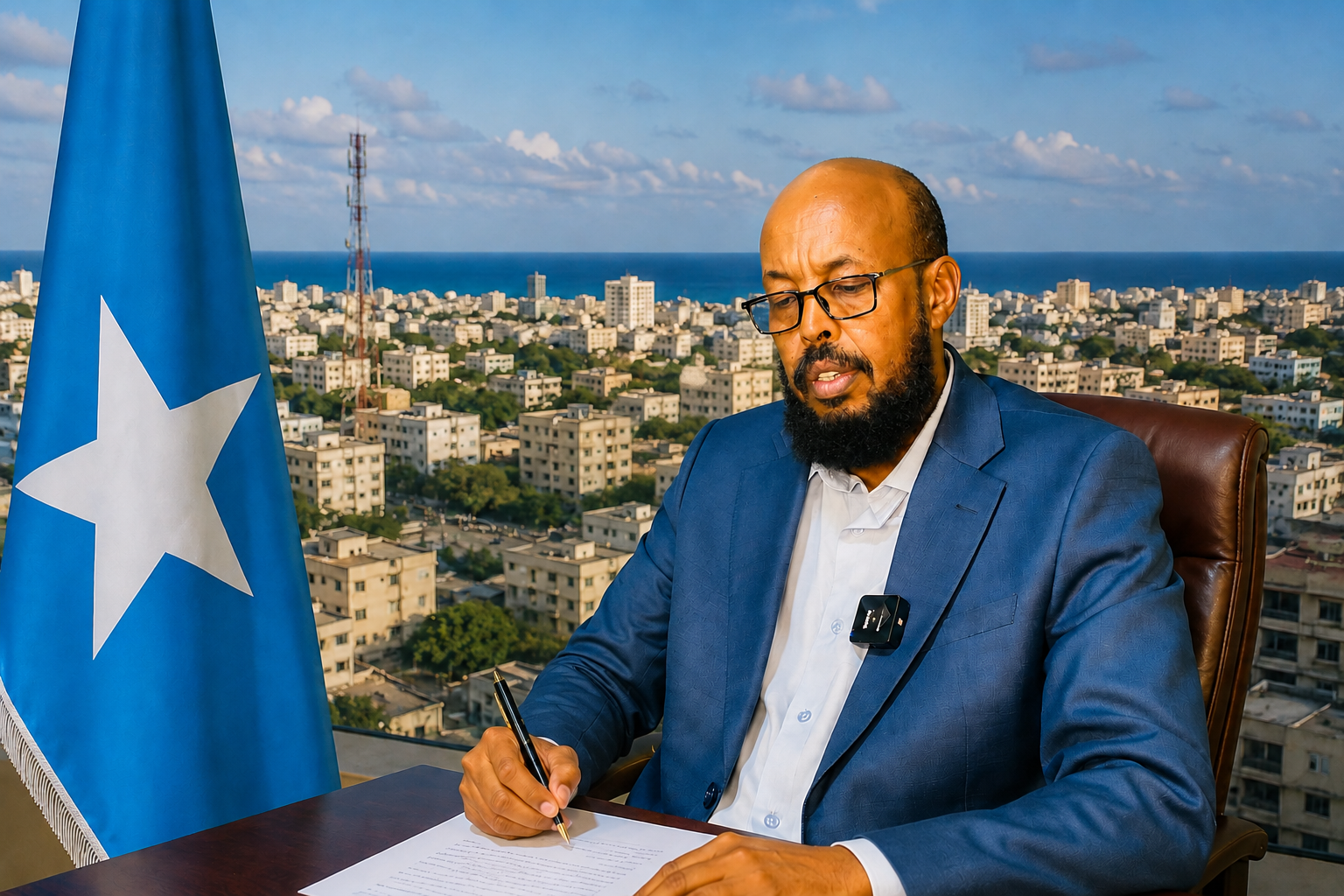

In recent years, and particularly amid recurring political tensions in Mogadishu, the Somali government has increasingly emphasized the need to disarm unauthorized armed groups and strengthen state control over weapons. The issue has become more pressing following recent violence in the capital, where armed confrontations between government forces and militias linked to opposition groups led to civilian suffering, displacement, and renewed fears of instability. International actors, including the United Nations and the African Union, have repeatedly called for constructive dialogue and restraint rather than armed confrontation.
The question many Somalis ask is this: Why is the government trying to disarm the country, and could such a process genuinely contribute to Somali state-building?
To understand this issue, one must first recognize a central principle of modern governance: a functioning state must possess a monopoly over the legitimate use of force. Political scholars, international institutions, and legal systems widely recognize that governments—not clans, militias, private groups, or political factions—should be the only legitimate authority allowed to maintain armed forces within a country. This principle was famously articulated by sociologist Max Weber, who argued that a state is defined by its claim to the legitimate use of force within a defined territory. In simple terms, only the government should have the legal authority to carry weapons in defence of national order.
For Somalia, this principle is especially important. Since the collapse of the central government in 1991, Somalia has experienced decades of fragmented authority, where clan militias, warlords, extremist organizations, and political factions often possessed greater firepower than formal institutions. Such fragmentation weakened national unity and made governance difficult. A state can not effectively collect taxes, enforce laws, secure citizens, or administer justice if multiple actors maintain competing armed power.
The Somali government’s effort to disarm unauthorized actors can therefore be interpreted as an attempt to strengthen state institutions. If implemented genuinely, fairly, and inclusively, disarmament could help Somalia transition from a fragile political arrangement into a stronger modern state. For example, countries emerging from conflict such as Rwanda and Sierra Leone invested heavily in disarmament, demobilization, and reintegration programs to reduce militia influence and strengthen state institutions after civil war. These efforts helped restore relative stability and reduce the risk of politically motivated violence.
However, Somalia’s case is more complicated. The success of disarmament depends not merely on collecting weapons but on trust, fairness, and institutional legitimacy. If citizens or political actors believe that disarmament targets only certain clans or opposition groups while others remain armed, mistrust will deepen. Genuine disarmament can not be selective. It must apply equally to all actors regardless of political affiliation, clan identity, or regional influence.
Recent clashes in Mogadishu have highlighted these concerns. Government forces and opposition-linked militias exchanged fire in residential areas, resulting in civilian fear and international concern. While the government stated that opposition militias had been disarmed, some residents argued that violence subsided mainly due to mediation efforts rather than complete disarmament. International partners urged all Somali leaders to resolve their differences through dialogue instead of military confrontation.
The United Nations has long supported arms control and weapons management in Somalia. International programs have worked with Somali authorities to improve weapons registration, ammunition management, and oversight mechanisms to ensure that firearms remain under accountable institutions. These efforts are based on the understanding that uncontrolled weapons proliferation undermines peacebuilding and increases insecurity.
If Somalia genuinely pursues disarmament, the benefits could be substantial. First, it would improve security by reducing the likelihood of political disputes turning violent. Second, it would strengthen public confidence in institutions such as the police and the military. Third, it would create conditions more favourable for investment, economic recovery, and social stability. No serious investor wishes to operate in an environment where armed factions can challenge state authority at any moment.
Most importantly, genuine disarmament could help Somalia move beyond clan militarization toward citizenship-based governance. Citizens would increasingly rely on institutions rather than private militias for protection. This transition is essential if Somalia hopes to become a stable democratic state.
Nevertheless, the process must be handled wisely. Disarmament should be accompanied by political inclusion, dialogue, justice, and opportunities for former fighters to reintegrate into society. Otherwise, weapons may simply disappear temporarily and re-emerge during political crises.
In the end, Somalia does not merely need fewer guns; it needs stronger trust between citizens and institutions. A government that genuinely seeks national stability must ensure that disarmament becomes a national project for peace, not a political tool against rivals. Only then can Somalia truly achieve the state-building process that many citizens have long hoped for.
Mohamed Mohamoud Adde is an academic and a geopolitical analyst