

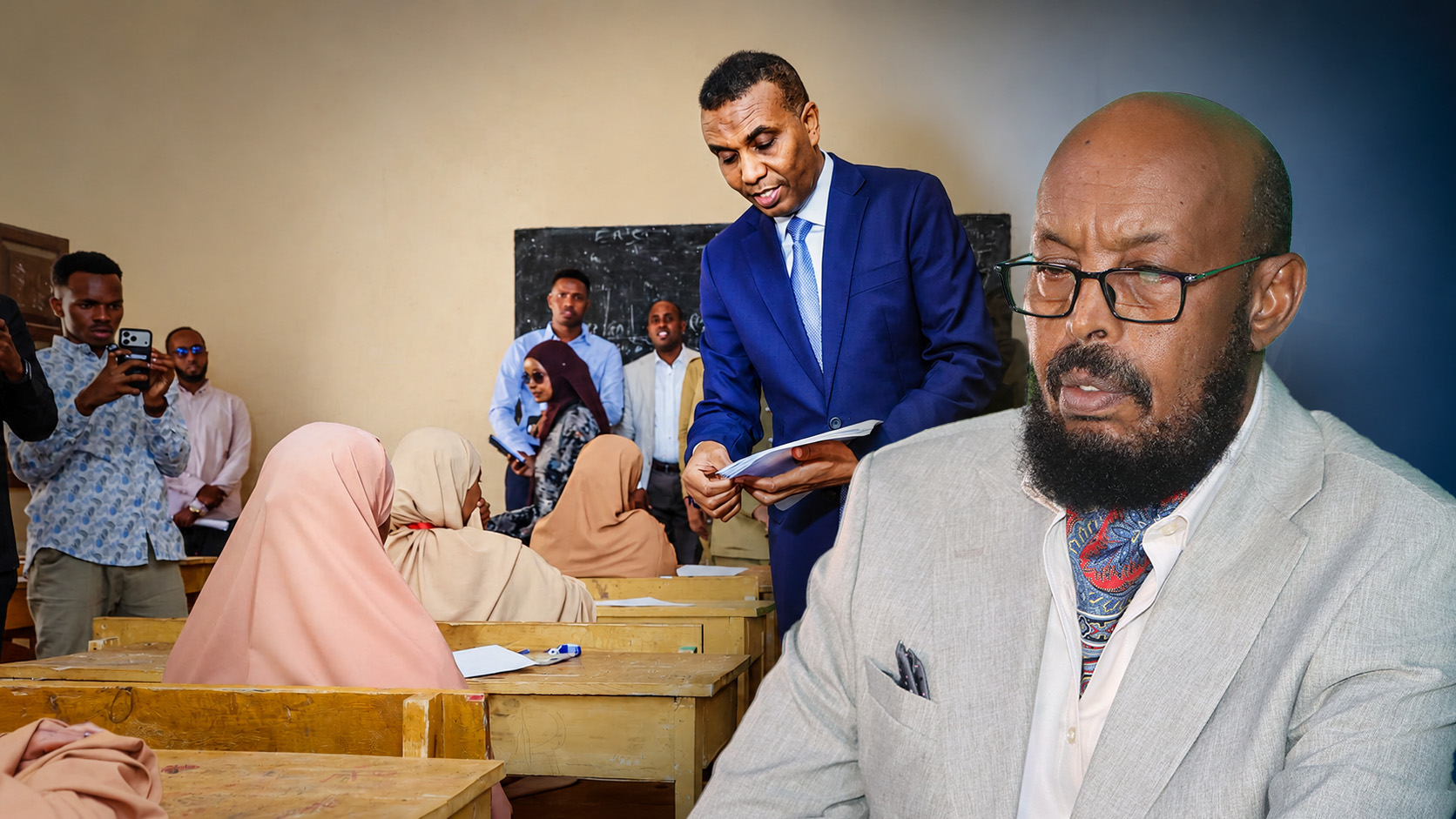

The 2025–2026 academic year is drawing to a close. Final national examinations for Year 8 students commenced last week, while secondary school leaving examinations began this week. Together, approximately 80,000 students across Somalia are sitting these examinations. Their achievement deserves recognition and celebration. However, the figure also reveals a troubling reality about the state of education in the country.
For a nation with an estimated population of more than 20 million people, 80,000 examination candidates are alarmingly low. A country of Somalia’s size should be producing several hundred thousand students reaching primary and secondary completion each year. Instead, the examination statistics indicate that millions of children are either not enrolled in school, have dropped out before reaching examination level, or have never had access to formal education.
The concentration of examination candidates in Mogadishu and other urban centres exposes another serious challenge. Educational opportunities remain heavily skewed in favour of city dwellers. Urban areas generally have more schools, better infrastructure, more qualified teachers, and greater access to educational resources. By contrast, many rural communities and remote districts continue to suffer from a shortage of schools and learning facilities.
This imbalance poses a long-term challenge to national development. A country cannot progress if quality education remains largely concentrated in a few cities while vast sections of the population remain educationally disadvantaged. Educational inequality inevitably becomes economic inequality and social inequality.
The scale of the problem is reinforced by international assessments. The United Nations Children’s Fund (UNICEF) has reported that more than three million children in Somalia are out of school. UNICEF has repeatedly emphasised that every child has the right to learn. This means that millions of Somali children are currently deprived of one of the most fundamental rights necessary for personal and national development.
The reasons behind low school enrolment are numerous and interconnected. Poverty remains perhaps the biggest obstacle. Many parents cannot afford school fees, uniforms, books, and transportation costs. For families struggling to meet their daily needs, education often becomes a luxury rather than a priority.
Displacement has also severely disrupted education. Years of conflict, recurring droughts, floods, and insecurity have forced millions of Somalis to move repeatedly from one place to another. Children living in displacement camps frequently have limited or interrupted access to schooling.
The shortage of qualified teachers and inadequate educational infrastructure present additional challenges. In many parts of the country, schools are either insufficient in number or entirely absent. Some children continue to study in temporary structures with limited teaching materials and poor sanitation facilities. Long distances to schools discourage attendance, especially among younger children and girls.
The consequences of educational exclusion are profound. Children who remain outside school are more vulnerable to poverty, exploitation, early marriage, and criminal activities. Equally concerning is the fact that every child denied education represents lost human potential. Among the millions of children currently out of school are future doctors, teachers, engineers, journalists, entrepreneurs, and public servants whose talents may never be fully realised.
Education is not simply a social service; it is the foundation of national development. No country can achieve lasting peace, economic growth, or political stability, while millions of its children remain outside the classroom. Every sector of society depends upon an educated population.
The government, therefore, needs to launch a massive nationwide campaign promoting primary education for all. Such a campaign should make one message absolutely clear: education is not a privilege reserved for urban residents or wealthy families but a fundamental right of every Somali child.
The campaign must involve government institutions, local authorities, religious leaders, community elders, civil society organisations, and the media. Parents should be encouraged to enrol their children in school, particularly girls and children living in rural areas.
At the same time, investment in educational infrastructure is essential. More schools need to be built in underserved communities, more teachers must be trained and deployed, and learning materials should be made affordable and accessible. The private sector can also contribute through scholarships and educational investments.
The approximately 80,000 students sitting national examinations this year represent hope for Somalia’s future. Yet their achievement should also serve as a national wake-up call. A nation of more than 20 million people can not be satisfied with these numbers. Somalia’s future prosperity depends on ensuring that every child has access to quality primary education and the opportunity to progress through the educational system. Increasing school enrolment today is not merely an educational policy; it is an investment in a more educated, productive, and stable Somalia tomorrow.
Mohamed Mohamoud Adde is an academic and geopolitical analyst