

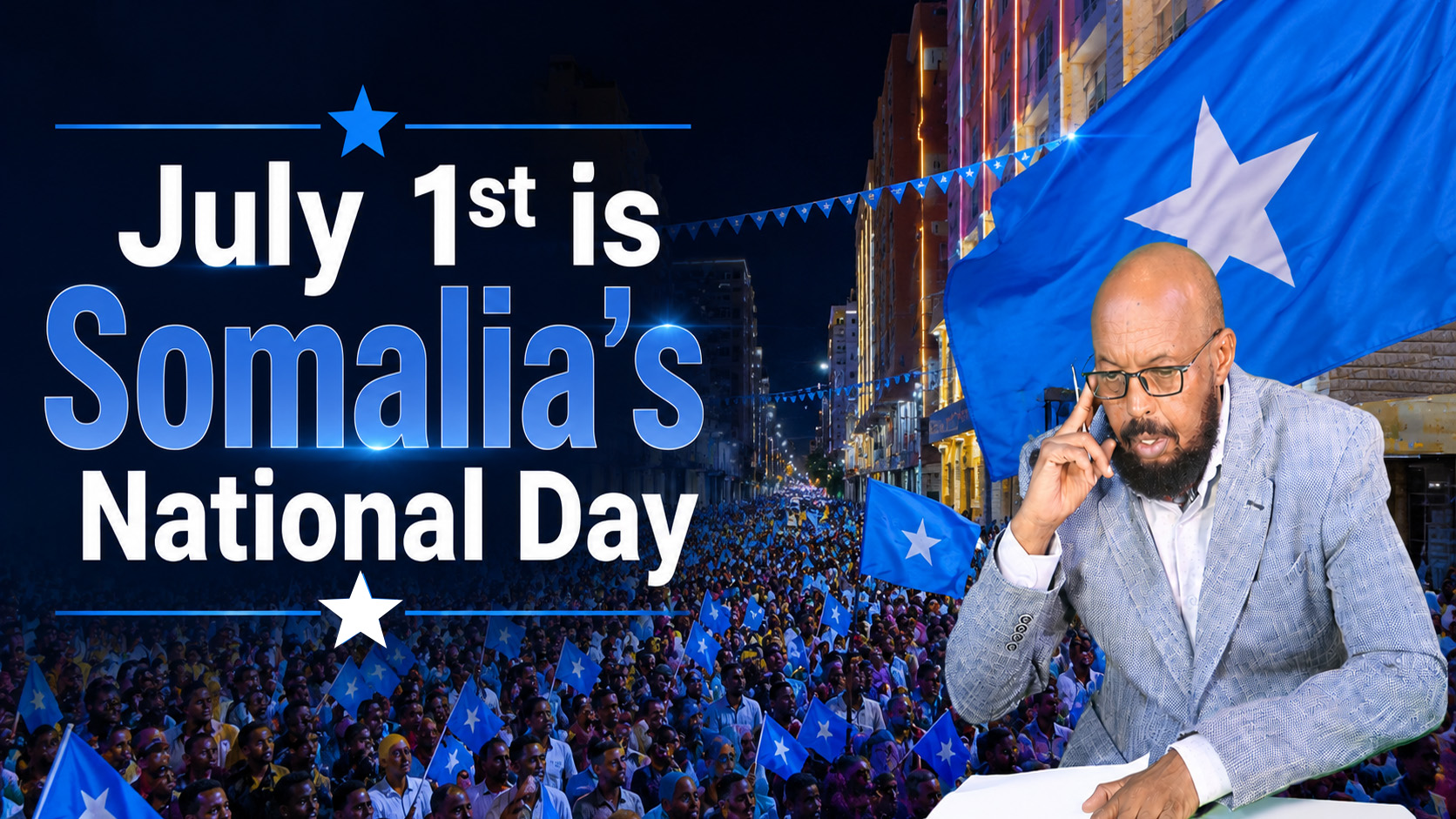

History has its defining moments—those rare moments when the destiny of a nation changes forever. For Somalia, one such moment arrived at the very first minute of 1 July 1960. As the clock struck midnight in Mogadishu, celebrations erupted across the city. The Somali flag was raised, colonial rule came to an end, and a new nation—the Somali Republic—was born through the voluntary union of the former British Somaliland and the Trust Territory of Somalia.
Even today, sixty-six years later, the echoes of that historic midnight still resonate. Every year on 1 July, Mogadishu comes alive with patriotic songs, cultural performances, public ceremonies, and the fluttering of blue flags carrying the white five-pointed star. The celebrations are more than a remembrance of independence; they are a reminder of a shared national dream and the enduring responsibility of every Somali citizen.
The road to that memorable night was long and demanding. Somalia’s people had endured decades of colonial rule under different European administrations. Yet throughout those difficult years, Somalis never abandoned their desire for self-rule. Nationalist movements, intellectuals, poets, elders, women, youth, and freedom fighters all contributed to a growing movement that demanded independence.
The formation of the Somali Youth League (SYL) in 1943 became a turning point in Somalia’s political awakening. The organisation united people across clan and regional lines around one central idea: an independent and united Somali nation. Through peaceful political mobilisation and determined advocacy, the SYL inspired thousands to believe that freedom was not merely a dream but an achievable goal.
That dream began to materialise on 26 June 1960, when British Somaliland gained its independence. Five days later, on 1 July 1960, the Trust Territory of Somalia also achieved independence. Rather than existing as two separate sovereign states, the leaders of both territories made a historic decision to unite immediately and establish the Somali Republic. Few newly independent African countries experienced such a voluntary political union at the moment of independence.
For many Somalis, that union symbolised far more than a constitutional agreement. It represented the hope that a people sharing one language, one faith, and a rich common culture could build a prosperous nation together. The light blue flag bearing the white star became a powerful emblem of sovereignty, dignity, and unity. The five points of the star reflected the broader aspiration of bringing together Somali-inhabited territories across the Horn of Africa.
The excitement of independence was accompanied by enormous expectations. Citizens believed that political freedom would pave the way for better education, stronger institutions, economic progress, and social justice. Schools were expected to educate future leaders, public servants were entrusted with serving the nation honestly, and the press was encouraged to strengthen democracy by informing the public and promoting accountability.
Although Somalia has experienced periods of political instability, conflict, and state collapse since independence, the significance of 1 July has never diminished. Instead, it has become an annual opportunity to reflect not only on past achievements but also on the unfinished work of nation-building.
History teaches that independence is not a destination but the beginning of a continuous journey. Freedom brings responsibility. Nations flourish when citizens respect the rule of law, value education, reject corruption, and work together despite political or social differences. The pioneers of Somali independence understood this truth well. They recognised that national unity would remain the country’s greatest strength.
Today’s generation has perhaps the most important role of all. More than half of Somalia’s population was born long after the events of 1960. Many young people know Independence Day only as a public holiday. Yet behind every celebration lies a profound lesson about sacrifice, leadership, and patriotism. Young Somalis should study the history of independence not simply to remember the past but to understand the values that built the nation.
Education remains one of the strongest pillars for preserving those values. Schools and universities should use Independence Week to teach students about Somalia’s constitutional development, nationalist movements, and the contributions of the men and women who fought for freedom. Journalists, historians, and writers also have a duty to document these stories accurately so that future generations inherit knowledge rather than myths.
The Somali diaspora, now spread across every continent, also shares in the significance of 1 July. Their investments, professional expertise, humanitarian assistance, and educational contributions demonstrate that patriotism extends beyond geographical borders. Wherever Somalis live, Independence Day serves as a reminder of their enduring connection to their homeland.
This year’s celebrations in Mogadishu carry particular meaning as Somalia continues its efforts to strengthen governance, expand economic opportunities, improve security, and deepen democratic institutions. The country’s future will not be determined solely by governments but by the collective commitment of its citizens to uphold the ideals that inspired independence.
As Somalis gather today beneath the blue flag, they honour not only a historic achievement but also an enduring promise. The heroes of independence entrusted future generations with a nation built upon hope, unity, and resilience. The greatest tribute to their sacrifice is to preserve peace, strengthen public institutions, promote reconciliation, invest in education, and place the national interest above personal or clan interests.
The first minute of 1 July 1960 changed the course of Somali history forever. The task of today’s generation is to ensure that the promise born at that unforgettable midnight continues to illuminate Somalia’s future.
Happy Independence Day. May the spirit of unity, patriotism, and hope that gave birth to the Somali Republic continue to inspire every Somali, at home and abroad, for generations to come.
Mohamed Mohamoud Adde is an academic and a geopolitical analyst.