

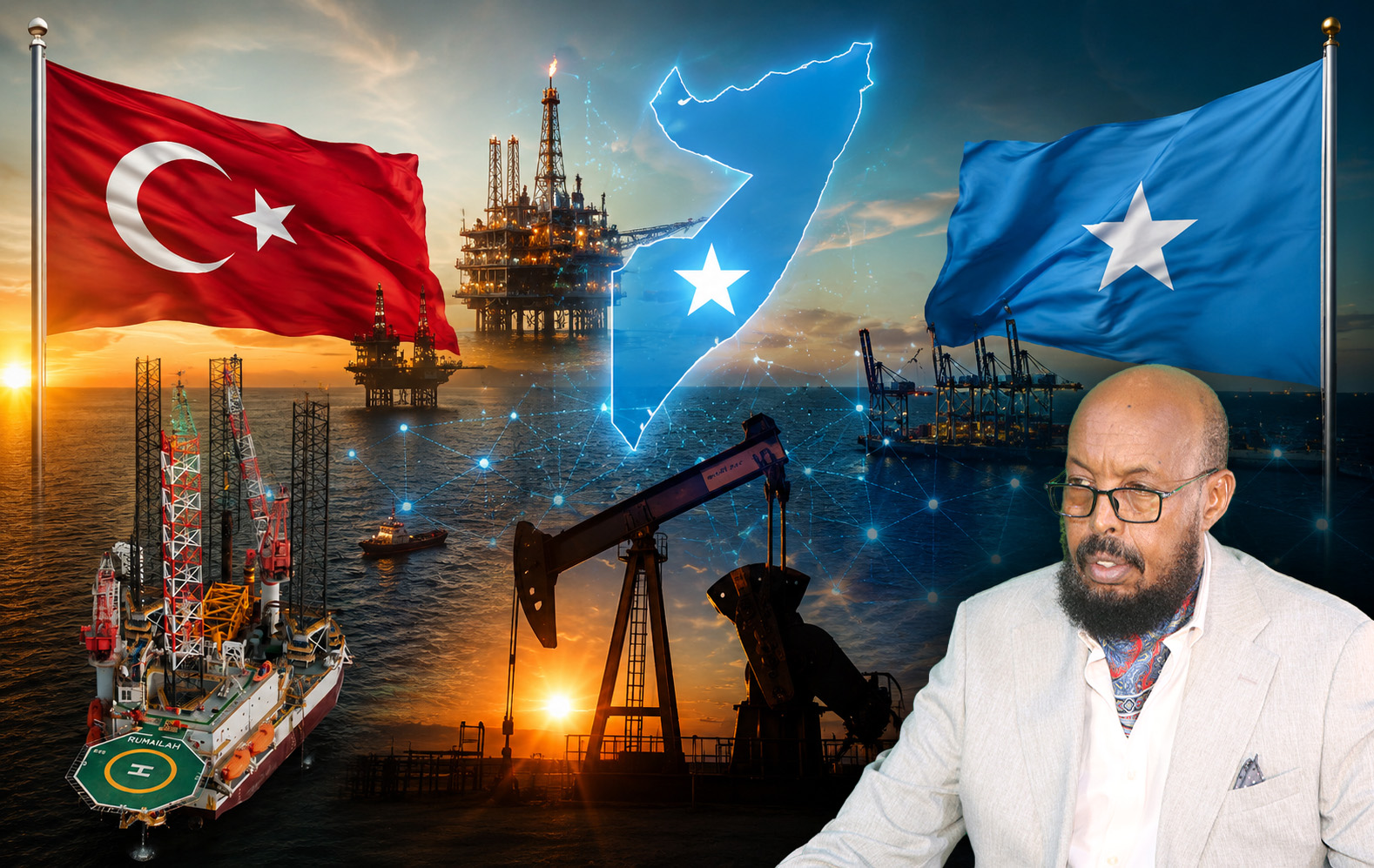

For more than three decades, Somalia’s oil wealth existed largely as a matter of speculation. Geologists spoke of enormous potential hidden beneath the waters of the Indian Ocean, but conflict, instability and weak institutions prevented the country from exploring its offshore resources. Today, however, that long-held dream appears to be moving closer to reality.
Somalia’s energy sector has entered a new era, driven by an increasingly important partnership with Türkiye.
Six offshore blocks have already been awarded to three companies: Liberty Petroleum, Coastline Exploration and the Turkish Petroleum Corporation (TPAO). While Liberty and Coastline have yet to commence major exploration activities, TPAO has moved with remarkable speed and determination.
The arrival of the Turkish seismic research vessel, Oruç Reis, in Somali waters last year marked a historic milestone. Equipped with some of the world’s most advanced exploration technology, the vessel spent months scanning the seabed and collecting seismic data from three offshore blocks covering approximately 15,000 square kilometres.
According to Turkish Energy Minister Alparslan Bayraktar, the seismic studies have now been completed and preparations are underway for the next phase: drilling. He described the initial findings as highly encouraging and indicated that deep-water drilling operations are expected to begin in 2026.
What has captured the attention of both Somalis and international investors, however, are reports emerging from Turkish and regional business circles regarding the potential size of the discoveries.
According to preliminary estimates reported by Business Insider and cited by several regional media outlets, each of the first two surveyed blocks may hold around 10 billion barrels of oil. That would amount to approximately 20 billion barrels from just two blocks.
Although these figures still require confirmation through exploratory drilling and independent reserve certification, they have generated tremendous excitement. If eventually verified, the discoveries would rank among the most significant offshore finds in recent African history.
The numbers become even more striking when viewed in a broader context.
International assessments have often estimated Somalia’s total petroleum potential at around 100 billion barrels of oil and gas resources, although exact figures vary considerably among experts. If two blocks alone contain around 20 billion barrels, that would represent nearly one-fifth of Somalia’s estimated hydrocarbon wealth.
Even more astonishing is the fact that Somalia possesses around 204 offshore blocks that remain largely unexplored.
Of course, geology does not work in a simple mathematical pattern, and it would be unrealistic to assume that every block contains the same quantities of oil. Yet even a modest success rate could be transformational. If only five percent of the remaining blocks were found to contain deposits of similar size, Somalia’s overall petroleum endowment could rival that of some of the world’s major oil-producing nations, including Saudi Arabia and Venezuela.
Such possibilities explain why interest in Somalia’s offshore basin is growing rapidly.
Yet oil alone does not make nations prosperous.
History offers sobering lessons. Some resource-rich countries have struggled with corruption, political conflict and economic mismanagement despite possessing enormous oil reserves. The so-called “resource curse” has repeatedly shown that natural wealth can become a source of instability when institutions are weak.
For Somalia, therefore, the challenge is not merely discovering oil but managing it wisely.
The country’s petroleum resources have the potential to finance roads, ports, airports, hospitals, schools and universities. Oil revenues could create industries, generate employment and reduce dependence on foreign assistance. They could also attract significant investment from the Somali diaspora and international companies that have long viewed Somalia as a risky destination.
At the same time, the petroleum sector will require patience and careful planning.
Offshore drilling is among the most complex and expensive activities in the global energy industry. Drilling wells thousands of metres below the ocean surface demands advanced technology, billions of dollars in investment and highly specialised expertise. Even after commercially viable reserves are confirmed, it could take several years before Somalia sees large-scale production and meaningful revenues.
Moreover, energy wealth must be accompanied by strong governance. Transparent contracts, accountable institutions and equitable revenue-sharing mechanisms will be essential. Every Somali community must feel that the country’s natural resources belong to all citizens and that the benefits are distributed fairly.
The encouraging aspect of the Turkish partnership is that it extends beyond energy. Over the past decade, Türkiye has become one of Somalia’s most significant development partners, investing in infrastructure, education, humanitarian assistance and security cooperation. This broader relationship has created a level of trust that may prove invaluable as Somalia enters the complex world of petroleum development.
For generations of Somalis, oil was little more than an unrealised possibility hidden beneath the sea. Today, seismic surveys suggest that the promise may be genuine and that the waters off Somalia’s coast could contain extraordinary wealth.
But the true significance of Somalia’s oil reserves will not ultimately be measured in billions of barrels.
It will be measured by whether this wealth improves the lives of ordinary citizens, creates opportunities for young people and lays the foundations for lasting peace and prosperity. Somalia now stands before a rare historical opportunity: to transform geological promise into national development and to ensure that the riches beneath the Indian Ocean become a blessing for generations yet to come.
Mohamed Mohamoud Adde is an academic and a geopolitical analyst